 Choreograph
Durable execution. Governed delegation.
Temporal and DBOS make execution durable. The harness builds the agent. Choreograph governs the work.
Authority, approvals, effects, provenance and audit on one typed task. Open source. Postgres-native. Built for human-AI operations.
Temporal
Your workflow can wait. Who can move it forward?
Temporal makes code durable. Choreograph makes delegation governed: who may act, which checks must pass, and what can happen next.
The bag cannot connect at Frankfurt. The AI finds a direct flight, but only in business class. A support lead must approve the exception before the passenger accepts the new journey.
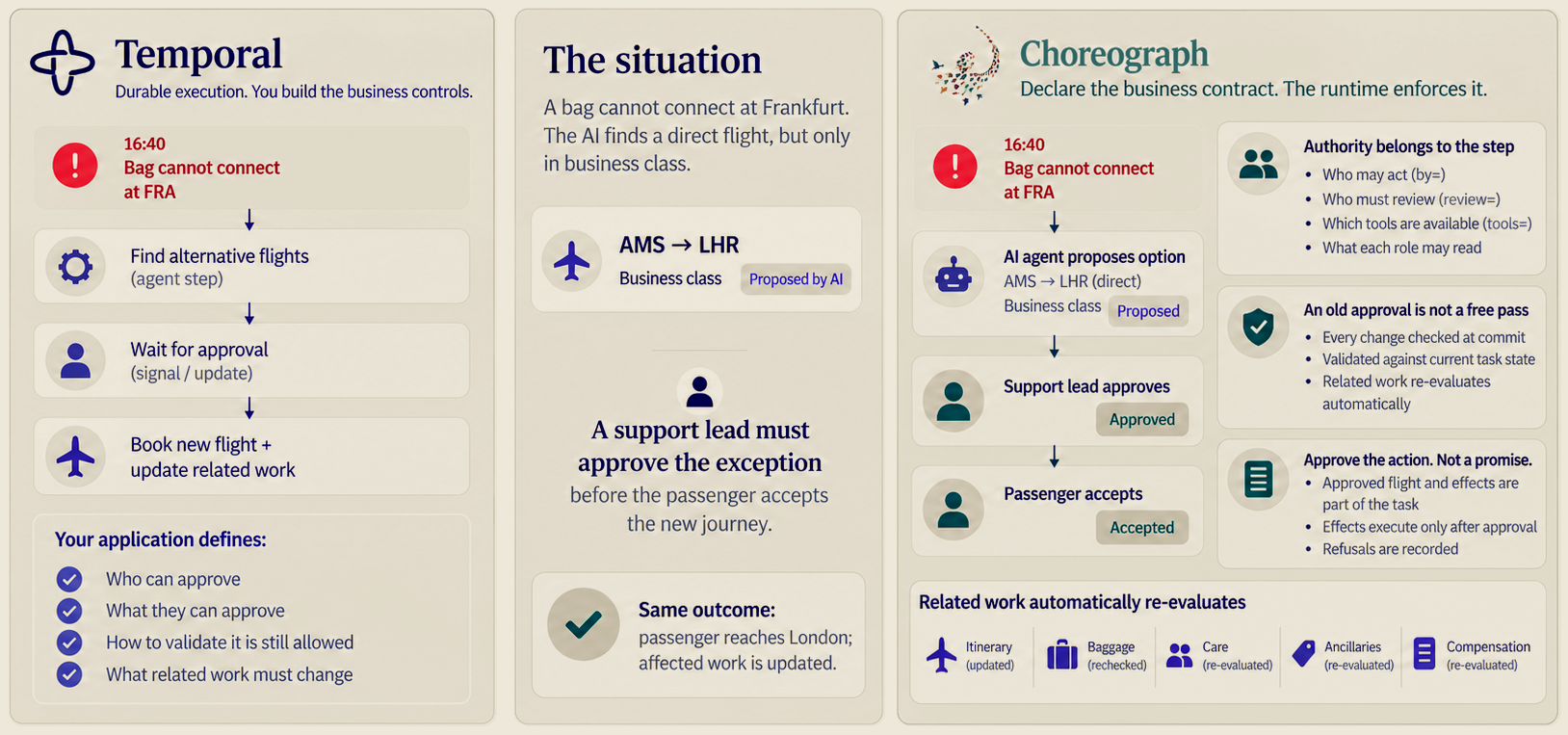
Illustrative airline workflow. The approval rule belongs to this example.
Temporal — build the business controls.
Workflow code, messages and validators carry the process. Your application defines business roles, approvals, scoped tools and dependent work.
Choreograph — declare the business contract.
States, roles, reviews, tools and dependencies live on the task. People and agents act against the same contract.
One business contract. Not a control framework rebuilt for every workflow.
Audit & replay
Replay the execution. Audit the decision.
Who approved it? Under which rules? What actually happened? Follow the decision across tasks, reviews, effects and evidence.
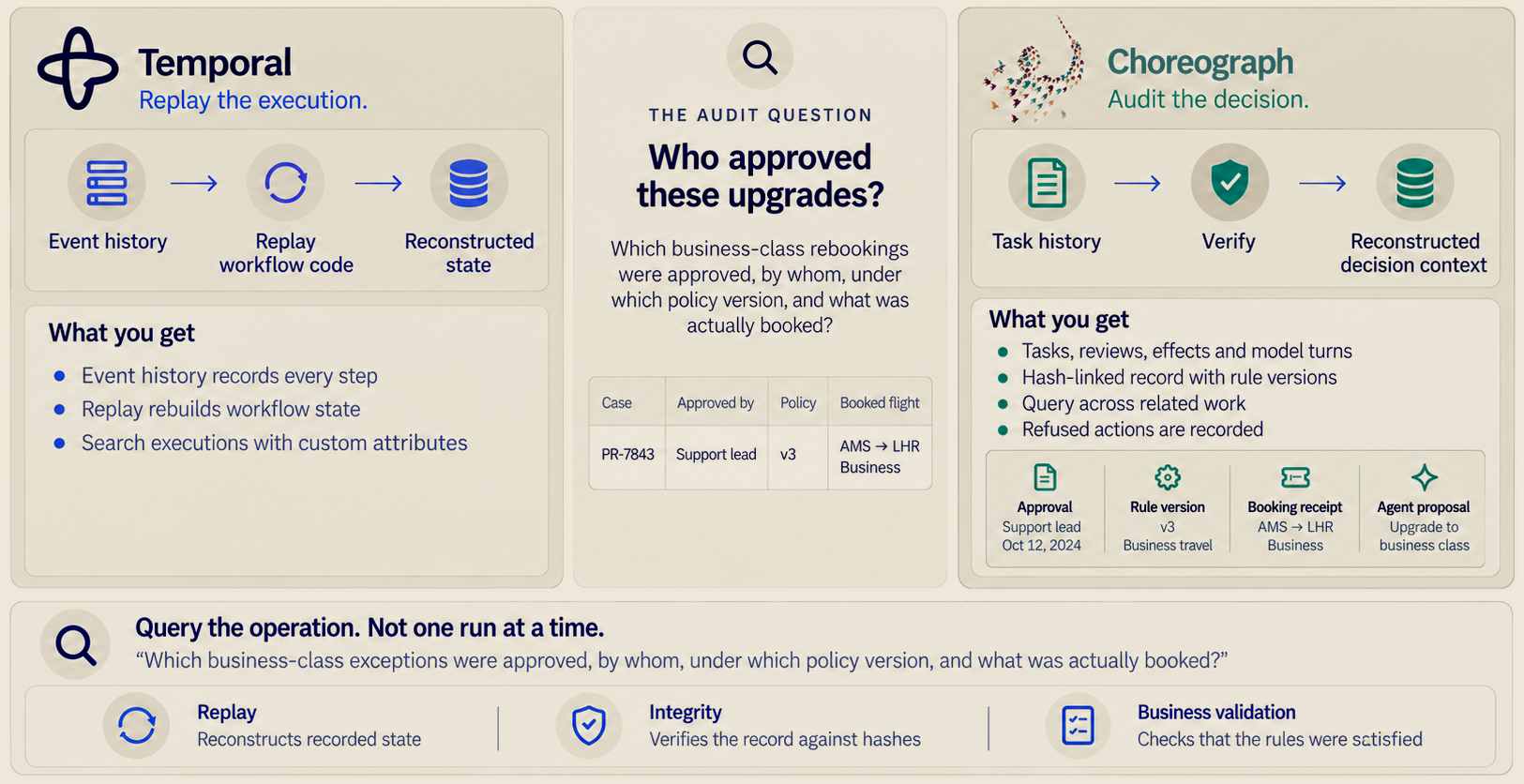
Temporal — replay the execution.
Event History plus Workflow code reconstructs execution state.
Choreograph — reconstruct the decision.
Join the change to its actor, approval, rule version, effects and evidence. Reconstruct the business state and verify the record.
How much infra do you want to run?
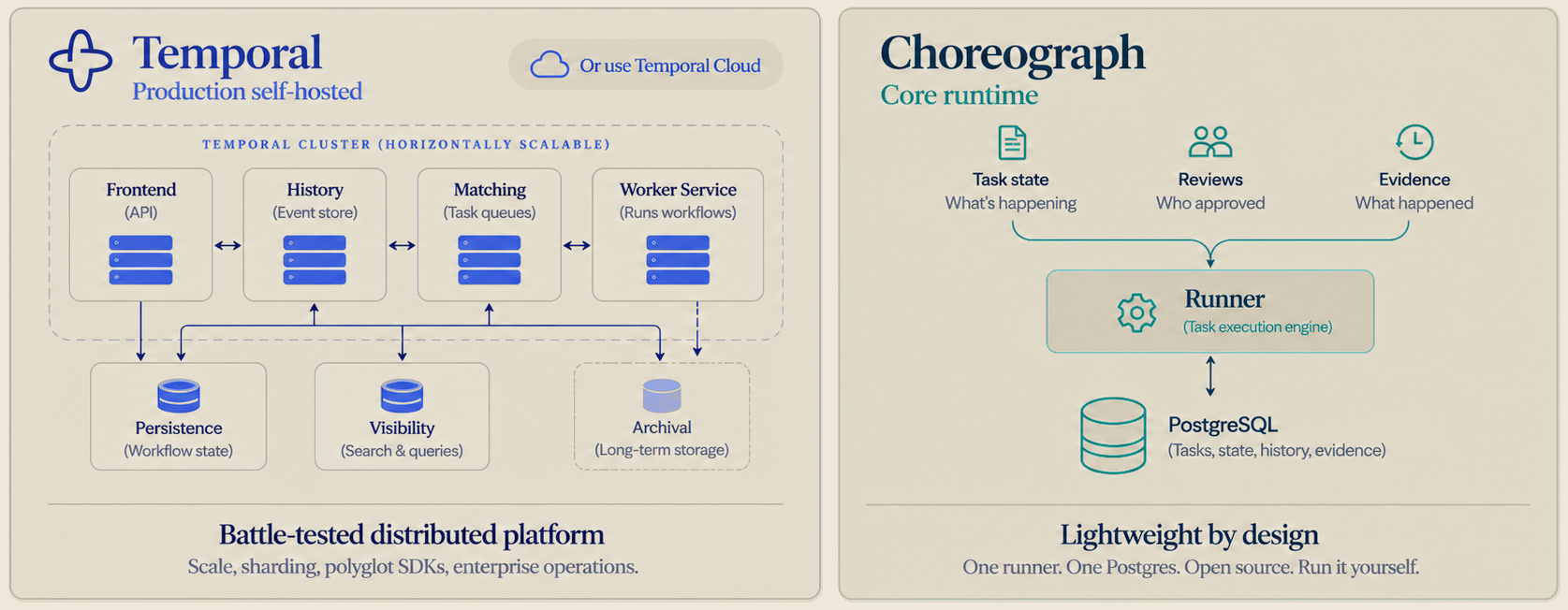
Temporal is the mature distributed platform. Choreograph is lightweight by design: one runner, one PostgreSQL database, open source and self-hostable.
What belongs to the platform?
| Concern | Temporal | Choreograph |
|---|---|---|
| Execution | Durable Workflow Execution | Durable typed business state |
| Authority | Application / integration logic | Declared on the task |
| Evidence | Event History + searchable metadata | Joinable business record |
| Replay | Reconstruct execution | Reconstruct decision context |
| Evolution | Version Workflow code | Version TaskType declarations |
Temporal is the stronger execution engine. Choreograph is the business contract it leaves you to model.
Temporal FAQ
Can’t I build this in Temporal?
Yes. Temporal is the mature choice for distributed durable execution. Choreograph’s proposition is different: keep authority, reviewed actions, dependent work and evidence in one task model instead of rebuilding that contract in every application.
Does Temporal already support audit and replay?
Yes. Choreograph’s distinction is the business record: actor, approval, pinned rules, effects, refusals and model evidence remain joined to the work and independently verifiable.
What about DBOS?
DBOS is the lightweight durability fit: durable workflows inside the app, backed by Postgres. Architecturally, it can sit beneath Choreograph while TaskTypes remain the business-process model.
Does Choreograph replace Temporal?
No. Temporal makes long-running code durable. Choreograph gives the business work a shared model for state, authority and evidence.
LangGraph
Keep the agent. Put authority outside its prompt.
LangGraph already supports code checks and human interrupts. Choreograph puts the business contract on the task, not in each agent’s implementation.
The same invoice, two ways.
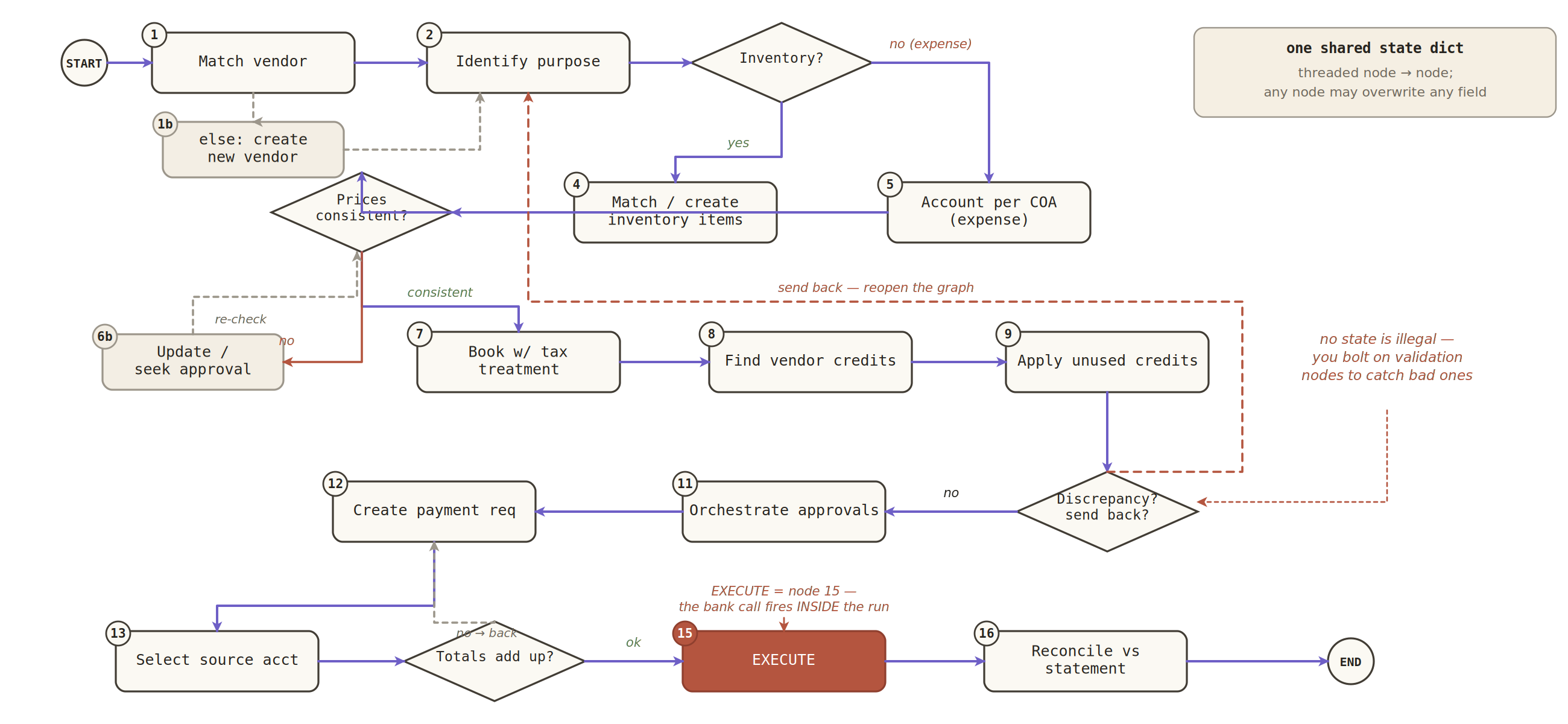
Sixteen steps take an invoice from inbox to reconciliation. The question is what those steps are.
Program-first · LangGraph (Guardrail)
The nodes are operations; arrows say “run this next.” Checks and approval routes are wired into the program. In this example, the bank call is node 15: it fires inside the run.
Task-first · Choreograph (Guarantee)
Four typed tasks declare states, actors and guards. An edge says “this actor may make this transition if its guard holds.” The Program is composed at run-time from the dependencies. INTAKE has no direct edge to PAID; that shortcut cannot be committed.
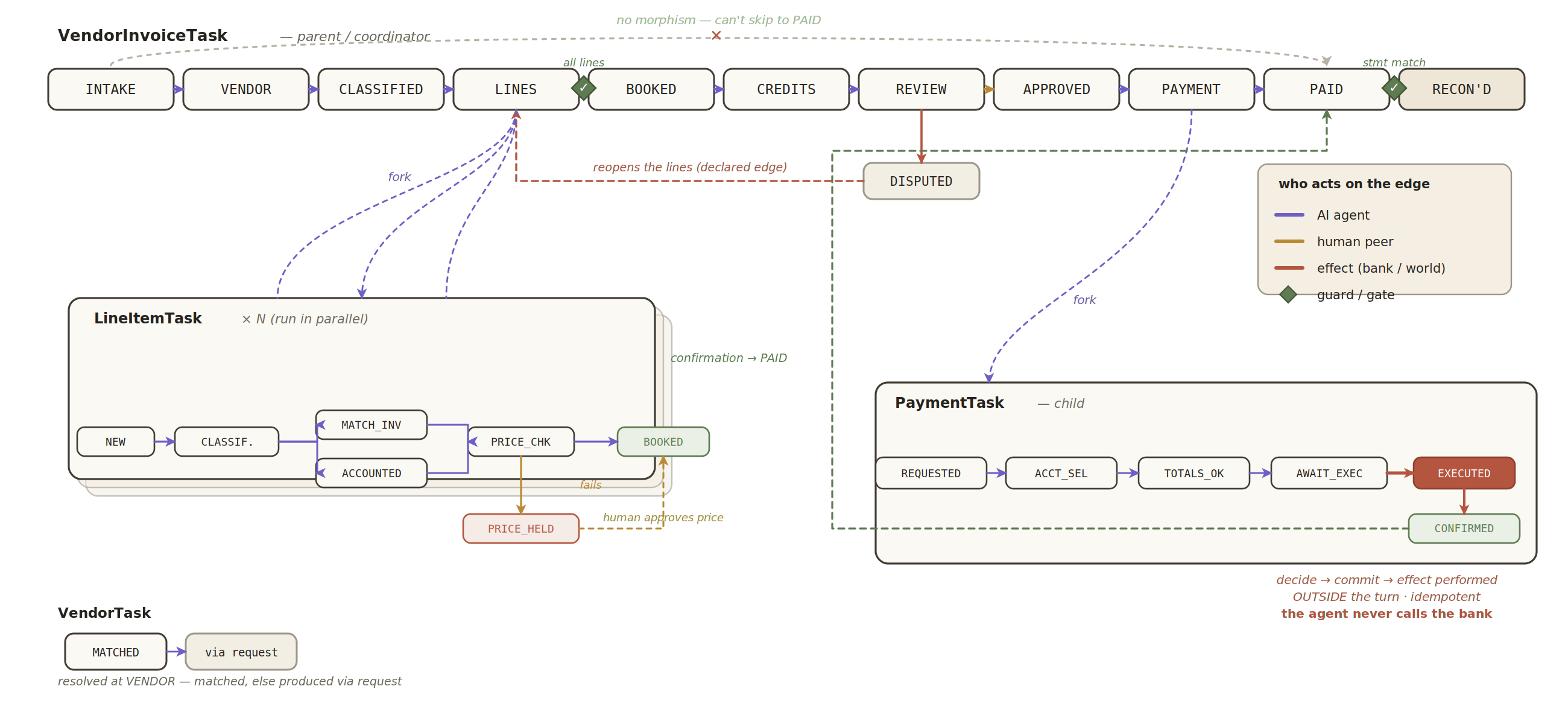
An arrow says what happens next. An edge says what may happen. What has no edge cannot happen at all.
Guardrail vs Guarantee
Program-first · LangGraph (Guardrail)
One process—the reasoning, the check, the bank call. The check is real, but it holds only as long as every path routes through it; the dashed line is the path nobody wired.
And because the tool fires mid-run, a check that fails late fails after the money moved.
Task-first · Choreograph (Guarantee)
The same agent thinks just as freely—but it can only propose. Every proposal crosses the Gate, where authorization, guards and the chain run inside the database transaction. What’s accepted becomes a commit; what’s refused becomes a commit too.
Only then does an idempotent executor touch the bank. Notice what the drawing has no arrow for: there is no path from the harness to the bank. That absence is the architecture.
A guardrail is something your program does. A guarantee is something done to your program.
Same rule. Three ways to control it.
Previous approved price: €100. Automatic booking up to €105. Above that, finance-lead review.
item_price <= 1.05 * previous_approved_price1. Prompt-only control
System instructions
Do not increase the price by more than 5%. Ask a person to approve larger increases.
Book at €108?
May still proceed
The model is instructed to comply. In this setup, no independent check stops a violating action.
2. Application validation
if proposed_price > approved_baseline * 1.05:
    require_human_review()
Book at €108?
Blocked by app code
A deterministic check stops the €108 proposal. Your team owns the validation path.
 3. Choreograph task guard
Automatic-booking transition
item_price <= 1.05 * previous_approved_price€104
Booked automatically
€108
Automatic path refused
Finance lead reviews exception
Approved exception
→ booked
The rule, the authority, and the recorded outcome live on the task.Refusal / approval recorded.
Prompt-only control
The model is asked to obey.
Application validation
Code enforces the check. Your application owns every path that must use it.
Choreograph task guard
The automatic path carries the rule. A failed guard routes to a separate human-authorised path; the refusal stays on record.
LangGraph overview · Human interrupts · Choreograph declaration
The workflow and the human.
| LangGraph | Choreograph | |
|---|---|---|
| Where does the workflow live? | In an executable graph of nodes and routes. | In a typed declaration: versioned, hash-pinned and enforced by the substrate. |
| What is the human? | An interrupt pauses the graph for human input; the program then resumes. | An authorised actor at the same Gate, with their own approval edge, lease and record. |
The LangGraph column describes the application-level setup shown here. Separate enforcement and audit services can be added; they are not supplied by the graph alone. Bank effects in Choreograph demonstrations are sandbox drafts.
Choose the runtime. Keep the business contract.
Temporal, DBOS and LangGraph solve different parts of the stack. Choreograph keeps the rules of the work in one place.
One database. One transaction boundary.
DBOS can commit application data and its durability record in Postgres. That makes it a natural durability layer under Choreograph while TaskTypes remain the home of business choreography.
Choreography in TaskTypes. Durability underneath.
Open source. One Postgres. Run it yourself.
Choreograph keeps task state, reviews and evidence in PostgreSQL. Bring your models and business systems. No orchestration cluster is required for the core runtime.
Enterprise when you need it. Lightweight when you don’t.
Open source under  Apache‑2.0 when the repository opens.
Pydantic AI is the reference harness. Temporal and DBOS are architectural fits here, not shipped adapters. Payment demos use sandbox drafts.
Stop rebuilding the rules around every agent.
Bring us the approvals, exceptions and audit work your team keeps stitching together. Put the business contract on the task.